I am trying to learn Kotlin coroutines, and was trying to learn more about how to handle errors from suspended functions. One of the recommended ways by Google is to create a “Result” class like the following:
sealed class Result {
    data class Success(val data: T) : Result()
    data class Error(val exception: Exception) : Result()
}
This allows us to take advantage of Kotlin’s when like following:
when (result) {
    is Result.Success<LoginResponse> -> // Happy path
    else -> // Show error in UI
}
However, I have recently stumbled into Kotlin’s runCatching {} API that makes use of native Result<T> class already available in standard lib since Kotlin v1.3
Here I will try to explore how the native API can replace the recommended example in the Android Kotlin training guide for simple use cases.
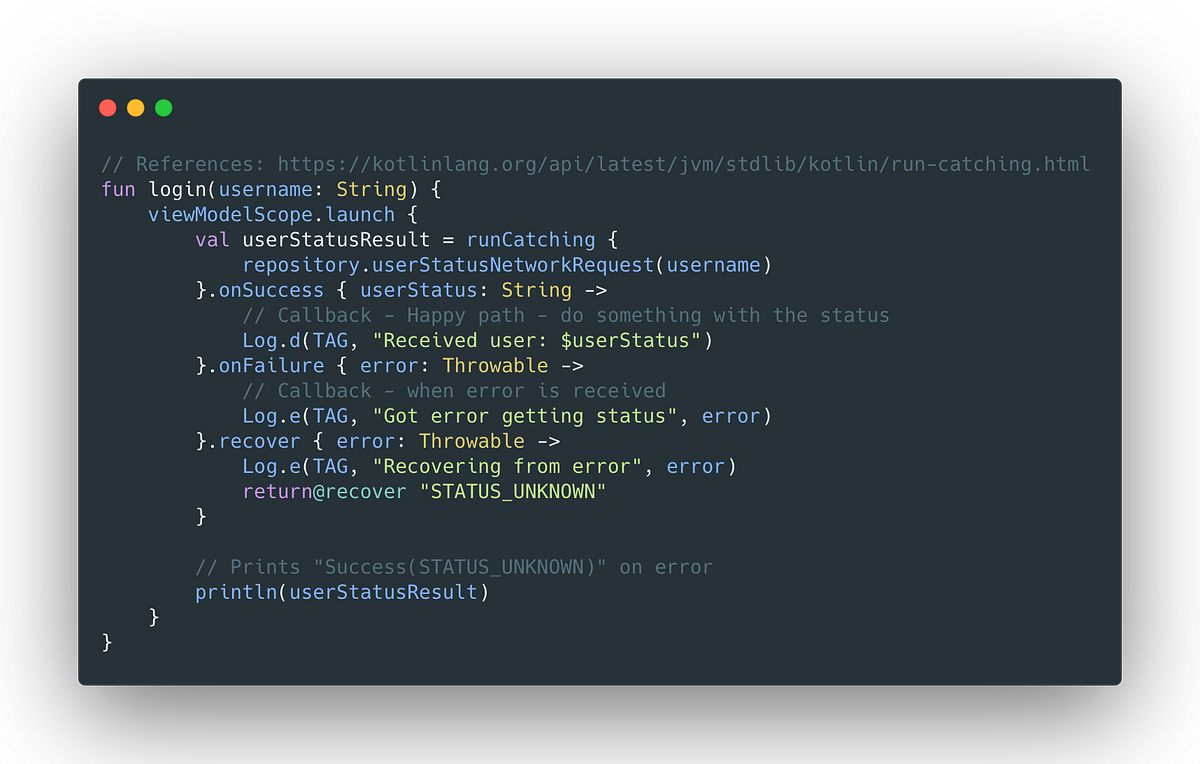
Here is a basic idea of how runCatching {} can be used from Android ViewModel.
Based on Kotlin standard lib doc, you can use runCatching { } in 2 different ways. I will focus on one of them, since the concept for the other one is similar.
To handle a function that may throw an exception in coroutines or regular function use this:
val statusResult: Result<String> = runCatching {
    // function that may throw exception that needs to be handled
    repository.userStatusNetworkRequest(username)
}.onSuccess { status: String ->
    println("User status is: $status")
}.onFailure { error: Throwable ->
    println("Got network error: ${error.message}")
}
// Assuming following supposed\* long running network API
suspend fun userStatusNetworkRequest(username: String) = "ACTIVE"Notice the ‘Result’ returned from the runCatching this is where the power comes in to write semantic code to handle errors.
The onSuccess and onFailure callback is part of Result<T> class that allows you to easily handle both cases.
How to handle Exceptions
In addition to nice callbacks, the Result<T> class provides multiple ways to recover from the error and provide a default value or fallback options.
- Using
getOrDefault()andgetOrNull()API
val status: String = statusResult.getOrDefault("STATUS_UNKNOWN")// Or if nullable data is acceptable use:
val status: String? = statusResult.getOrNull()Since the onSuccess and onFailure returns Result<T> you can chain most of these API calls like the following
val status: String = runCatching {
    repository.userStatusNetworkRequest("username")
}.onSuccess {}
.onFailure {}
.getOrDefault("STATUS_UNKNOWN")- Using
recover { }API
The recover API allows you to handle the error and recover from there with a fallback value of the same data type. See the following example.
val status: Result<String> = runCatching {
    repository.userStatusNetworkRequest("username")
}.onSuccess {}
.onFailure {}
.recover { error: Throwable -> "STATUS_UNKNOWN" }

println(status.isSuccess) // Prints "true" even if error is thrown- Using
fold {}API to map data
The fold extension function allows you to map the error to a different data type you wish. In this example, I kept the user status as String.
val status: String = runCatching {
    repository.userStatusNetworkRequest("username")
}.onSuccess {}
.onFailure {}
.fold(
    onSuccess = { status: String -> status },
    onFailure = { error: Throwable -> "STATUS_UNKNOWN" }
)
Aside from these, there are some additional useful functions and extension functions for Result<T> , take a look at official documentation for more APIs.
I hope this was useful or a new discovery for you as it was for me 😊
UPDATE #1: As Gabor has mentioned below, there is an unintended consequence about using it in coroutines. I will look into it and provide more updates on the usage soon. Thanks to Gabor for mentioning it.